
Strategy Defines Success: A Practical Guide to Institutional Planning for Digital Assessments
The rapid shift toward digital transformation in education has moved digital assessments from a nice-to-have to a necessity. However, simply replacing paper with screens often referred to as digitization, this is not the same as building a true digital assessment strategy.
Without a clear plan, institutions risk investing in expensive tools that fail to improve learning outcomes or operational efficiency. Real success comes from strategic planning, where technology aligns with pedagogical goals, staff capabilities, and institutional infrastructure.
This practical guide outlines a step-by-step approach to institutional planning for digital assessments, ensuring that technology supports education rather than complicates it.
A 5-Step Framework for Strategic Digital Assessment Planning
1. Start with a Clear Strategic Vision.
Before selecting platforms or tools, institutions must clearly define their purpose. Strategy begins with vision and direction.
Pedagogical Alignment
Are you trying to increase formative feedback, promote authentic assessment, improve grading efficiency, or reduce academic integrity risks? The goal should shape the technology choice.
Clear Institutional Goals
Develop a shared vision of what successful digital assessment looks like across departments and leadership levels.
Policy Review
Existing assessment policies should be updated to support digital methods, including guidelines on data privacy, accessibility, fairness, and academic integrity.
A strong foundation at this stage ensures that digital assessments are driven by educational outcomes rather than technology trends.
2. Evaluate Your Institution’s Digital Readiness.
Planning for digital assessment requires a clear understanding of the institution’s current capabilities.
Technical Infrastructure
Evaluate bandwidth, server capacity, device availability, and system stability to ensure the environment can support high-stakes digital exams.
Staff Competence
Faculty and administrators must have the digital skills needed to design, deliver, and evaluate online assessments effectively.
Student Experience and Access
Ensure that all students can access the required technology without disadvantage, maintaining equity and inclusiveness.
A realistic readiness assessment helps institutions avoid costly implementation mistakes and ensures a smooth transition.
3. Build a Structured and Phased Implementation Roadmap.
Going fully digital overnight can create operational and technical challenges. A phased approach reduces risk and improves long-term success.
Start Small with Pilot Projects
Test digital assessment tools in selected departments or courses to identify technical and operational gaps before scaling.
BYOD vs. Controlled Labs
Institutions must decide whether students will use their own devices or controlled computer labs, depending on their infrastructure and security needs.
Integrated Workflow
Digital assessment tools should integrate smoothly with the Learning Management System (LMS) to ensure efficient data management and reporting.
A structured roadmap ensures that implementation is gradual, controlled, and sustainable.
4. Empower Staff Through Training and Continuous Support.
Technology adoption depends heavily on staff confidence and capability. Even the best tools will fail without proper training and support.
Professional Development
Educators should be trained not only on how to use digital platforms but also on how to design effective digital assessments and use performance data to improve learning outcomes.
Continuous Support System
Institutions should provide technical and pedagogical support through help desks, training sessions, and dedicated support teams.
When staff feel confident and supported, adoption becomes smoother and more sustainable across the institution.
5. Track Performance and Continuously Improve the System
Digital assessment planning is not a one-time project; it is a continuous cycle of improvement.
Key Performance Indicators (KPIs)
Reduction in grading time
Improvement in student feedback loops
System uptime and stability
Feedback and Iteration
Regular feedback from students and faculty helps identify usability issues and improvement opportunities, allowing institutions to refine their strategy over time.
Continuous evaluation ensures that digital assessment systems remain effective and aligned with institutional goals.
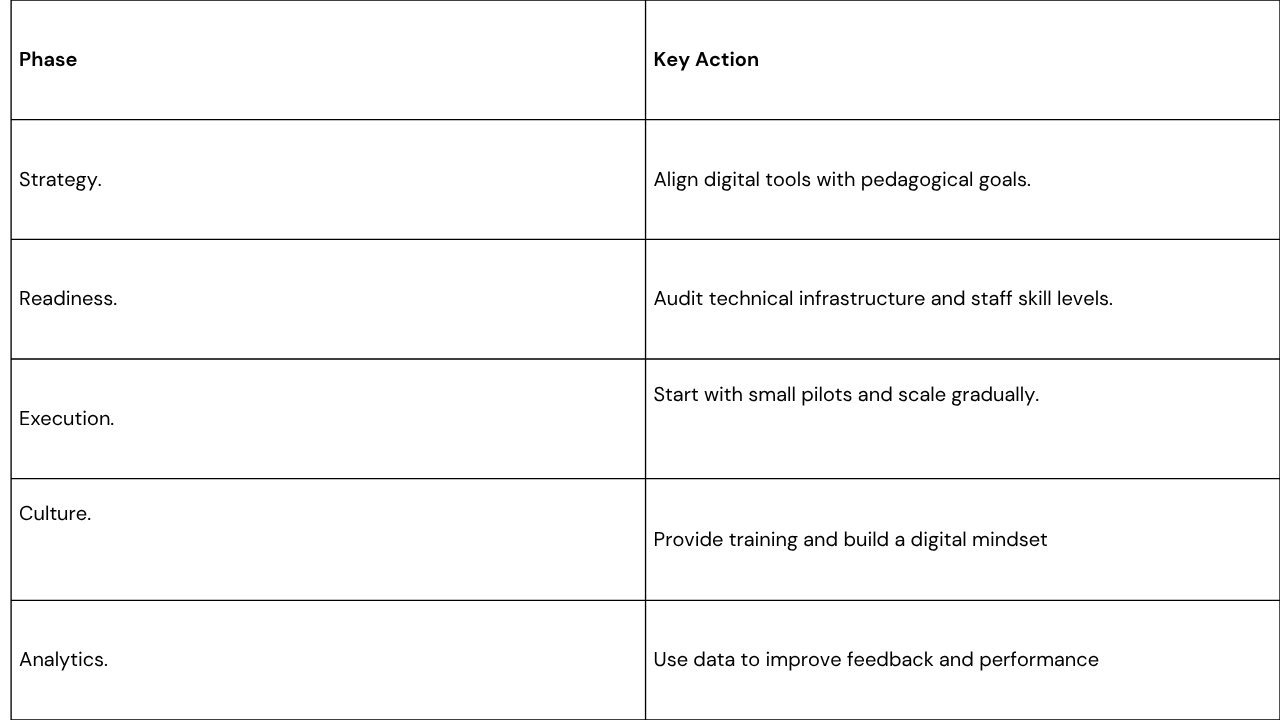
Summary Checklist for success.
Conclusion
The transition to digital assessments is more than a technological upgrade; it is a strategic shift in how institutions approach teaching, evaluation, and student success. With a structured and phased approach, institutions can build assessment systems that are efficient, scalable, and equitable.
Book a demo with Eye to see how our structured digital assessment solution can support your institution’s transformation: https://www.eyeproctor.com/
Subscribe now.
Get actionable insights and product updates that help you run more secure, scalable remote exams.

Eye enables fair, transparent proctoring through intelligent, event-driven monitoring. Built to protect trust for candidates and institutions




Get in touch
Copyright 2026 © Eye Team. All Right Reserved.